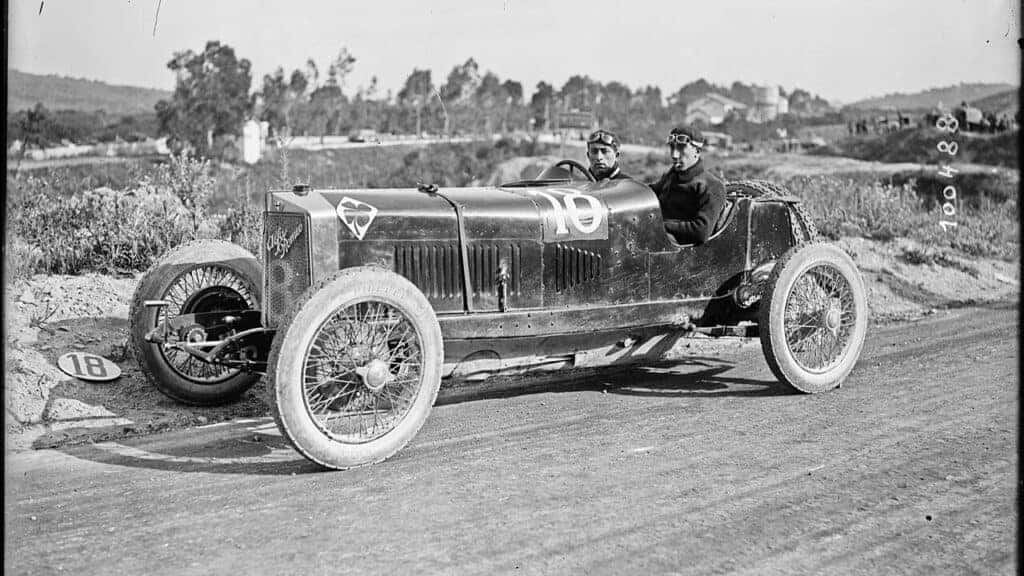
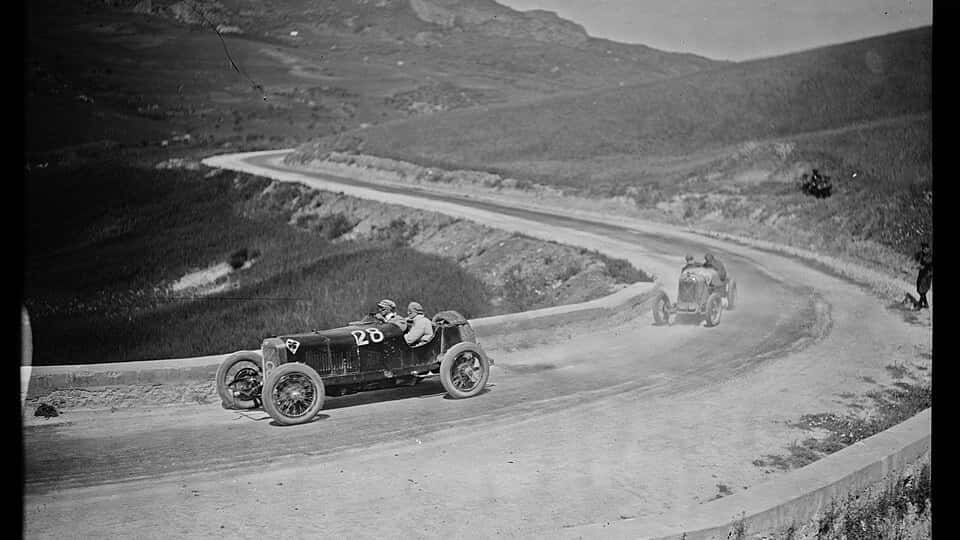
Alfa took 10 Targa Florio victories between 1923 and 1975.
Alfa Romeo won the Mille Miglia 11 times between 1928 and 1947, more than any other manufacturer.
The 8C 2300 won the 24 Hours of Le Mans four years in a row, from 1931 to 1934.
The Quadrifoglio badge was born at the 1923 Targa Florio and still marks Alfa’s fastest models.
Alfa Romeo built its racing reputation in endurance road racing, with 25 combined wins at the Mille Miglia, Le Mans and the Targa Florio. These races ran on public roads and through the night, testing durability as much as speed.
The record spans more than 50 years, from a 1923 win in Sicily to a 1975 victory with the Tipo 33. It’s a big part of why racing runs through the history of Alfa Romeo.
Targa Florio: 10 Wins in the Mountains of Sicily
Founded in 1906, the Targa Florio was the world’s oldest sports car race, run on mountain roads outside Palermo. The original course had roughly 2,000 corners per lap.
Alfa’s first Targa Florio win came in 1923, when Ugo Sivocci painted a four-leaf clover on his RL for luck. He was killed testing a new Alfa just months later, and the Quadrifoglio has marked Alfa’s fastest cars ever since.
1923
The first win
Ugo Sivocci's RL wears the first Quadrifoglio.
1930–1935
Six in a row
The P2, 8C 2300 Monza and Tipo B take six straight.
1950
Postwar victory
The Bornigia brothers win in a 6C 2500 Competizione.
1971
The Tipo 33 era
The 33/3 wins with Nino Vaccarella and Toine Hezemans.
1975
The 10th win
Vaccarella returns to win in the 33TT12.
*Ten Targa Florio wins between 1923 and 1975.
The 1933 win also completed a rare set. Tazio Nuvolari is the only driver to win the Targa Florio, the Mille Miglia and Le Mans in an Alfa Romeo, with five of those victories coming between 1930 and 1933.
Decades later, Sicily’s own Nino Vaccarella delivered Alfa’s last two wins in the Tipo 33, the race-car family behind the 33 Stradale.
The Mille Miglia: 11 Wins on Italy’s Public Roads
The Mille Miglia was a race of roughly 1,000 miles on Italian public roads, starting and finishing in Brescia. It ran from 1927 to 1957, and Alfa Romeo won it more than any other brand.
1928
6C 1500
1929
6C 1750
1930
6C 1750
1931
Other winner
1932
8C 2300
1933
8C 2300
1934
8C 2600 Monza
1935
Tipo B
1936
8C 2900 A
1937
8C 2900 A
1938
8C 2900 B
1939
No race
1940-46
Other winner, no race
1947
8C 2900 B
Alfa Romeo win (11)
Other winner or no race
Giuseppe Campari won the first two for Alfa, in 1928 and 1929. In 1930, the story goes, Tazio Nuvolari closed in on teammate Achille Varzi at dawn with his headlights off, then switched them on as he passed for the win.
Then came the 8C. From 1932 to 1938, Alfa’s supercharged eight-cylinder cars won seven Mille Miglias in a row, a streak no other manufacturer has matched.
When the race returned after World War II, the 8C was still the car to beat. Clemente Biondetti won in 1947 in an 8C 2900 B, the same model that had won in 1938, giving Alfa its 11th victory.
Le Mans: Four Straight Wins for the 8C 2300
First held in 1923, the 24 Hours of Le Mans runs on closed public roads in western France, testing cars through a full day and night. It’s still the world’s best-known endurance race.
Alfa’s answer was the 8C 2300, built around Vittorio Jano’s supercharged straight-eight. It won Le Mans every year from 1931 to 1934.
1931
8C 2300
Earl Howe and Sir Henry Birkin
1932
8C 2300
Raymond Sommer and Luigi Chinetti
1933
8C 2300
Tazio Nuvolari and Raymond Sommer
1934
8C 2300
Luigi Chinetti and Philippe Étancelin
The 1932 win came down to one driver. When Luigi Chinetti fell ill after a single shift, Raymond Sommer drove more than 20 of the 24 hours himself, even after a broken exhaust started pumping fumes into the cockpit.
The 1933 race was even closer, decided by about 10 seconds. Running on a cracked fuel tank plugged with chewing gum, Nuvolari swapped the lead three times on the final lap to win.
Alfa Romeo had withdrawn its factory team after 1932, so the last two wins went to privately entered cars. The 8C 2300 kept winning anyway.
Why Endurance Racing Shaped Alfa Romeo
Road races like these punished weak parts over hundreds of miles of rough roads. Winning them proved Alfa could build cars that were fast, balanced and durable at once.
Alfa even named cars after its races, from the RL Targa Florio to the Le Mans and Mille Miglia versions of the 8C 2300. Many were sold to private buyers as well as raced, setting the pattern of road cars shaped by competition.
Italy’s great coachbuilders shaped the bodies. Carrozzeria Touring bodied the 8C 2900 Bs that won the Mille Miglia in 1938 and 1947, and the same coachbuilder built the modern 33 Stradale.
The Racing Legacy in Today’s Alfa Romeo
The Quadrifoglio still marks Alfa’s highest-performance models, and the brand’s next chapter, the Alfa Romeo Cuorerosso concept, carries one too. Every 2026 Giulia, Stelvio and Tonale uses Alfa’s DNA drive modes to sharpen throttle, shifts and steering with one turn of a dial.
More than a century after Ugo Sivocci painted his clover for luck, the roads have changed but the idea hasn’t. Every Alfa Romeo is still built for drivers who want to feel the road, just as Campari, Nuvolari and Sommer did.
From the Targa Florio to your driveway
FEEL A CENTURY OF RACING FROM THE DRIVER’S SEAT
The same pursuit of balance and response shapes every Giulia, Stelvio and Tonale. Pick yours, and we’ll have it ready for a drive.
Ugo Sivocci painted a four-leaf clover on his car for luck before the 1923 Targa Florio, which he won. It has marked Alfa’s top performance models ever since.
This vehicle is being built now. Contact dealer to reserve this vehicle and discuss options for locking in pricing and eligible incentives.
Vehicles identified as “Being Built” are pre-production vehicles that are not yet on the dealer’s lot or in transit. Pre-production computer-generated images may be shown and may not be representative of the vehicle listed.
MSRP for standard equipment plus optional equipment listed. Vehicle delivery date and other vehicle information, including pricing and incentives, are subject to change until the vehicle build is complete.
MSRP excludes additional charges including without limitation any delivery fees, government fees and taxes, title and registration fees, finance, filing and processing charges, emission testing charge, accessories and upfits.